

Most of what I’ve read of Chaucer is from The Canterbury Tales. The reason Chaucer makes my list is the way I learned Chaucer. Contrary to a lot of jokes I like to make about school, there are worthy courses here and there, taught by worthy professors. I had the good fortune to get Kim Stafford as my Chaucer professor in his only year at UC Davis. We read Chaucer in the original Middle English. I had a leg up and maybe more on my classmates because I spoke German. Middle English has a lot of similarities. In addition to learning things like the start of the General Prologue, Kim gave us free reign to write essays in any manner we saw fit, if we had the courage.
Most of what I’ve read of Chaucer is from The Canterbury Tales. The reason Chaucer makes my list is the way I learned Chaucer. Contrary to a lot of jokes I like to make about school, there are worthy courses here and there, taught by worthy professors. I had the good fortune to get Kim Stafford as my Chaucer professor in his only year at UC Davis.
I saw fit to write The Student of Davis’s Tale and I also wrote Succex, a take on how the Wyf of Bathe and the Prioress succeeded in life on the backs of their physical wiles, or just on their backs. (I wrote many analytical essays in the form of stories, poems, plays, and alternative histories. I figured it would give profs something entertaining in the middle of a stack of cookie–cutter, soporific papers. Nobody asked me to stop.) Kim thought I had come up with some new interpretations of the text and asked if he could use them, although I don’t know if he ever did. In any case, it was a nice pump. I enjoyed analyzing Chaucer because his tales had so many layers of meaning. The more you dug into a tale, the more you thought about it, the deeper it got. And so Chaucer joined my list of favorite writers. I suspect that deeply analyzing a writer’s work either makes you love that author or hate that author.
We read Chaucer in the original Middle English. I had a leg up and maybe more on my classmates because I spoke German. Middle English has a lot of similarities. In addition to learning things like the start of the General Prologue, Kim gave us free reign to write essays in any manner we saw fit, if we had the courage.
The meaning of life, or at least a piece of it, is buried in his works, sometimes shining on the surface, sometimes concealed beneath subtle shades of significance. My favorite Shakespeare works are his tragedies, although the histories, comedies, and poetry are all worth reading. Few authors have the breadth to write in so many genres with such authority. Sorry, had to pun there, I’m weak. Shakespeare never would’ve stooped to that. Or, probably, he would. Please don’t Rosencranz my Guildenstern.

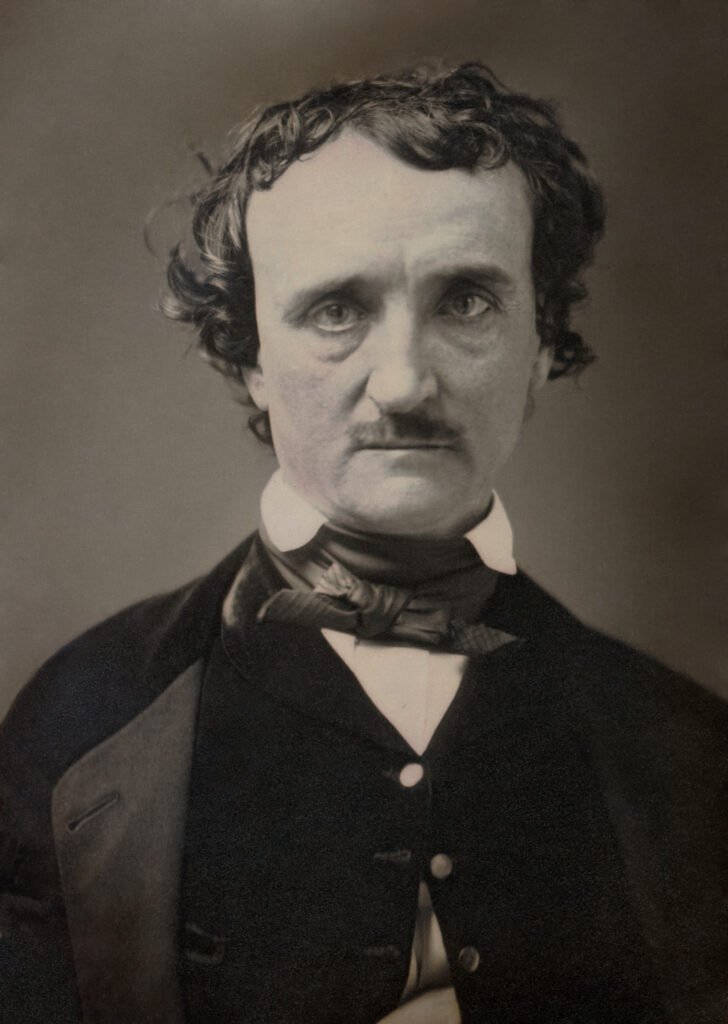
Before there was Rod Serling, there was Edgar Allan Poe. Twilight Zone fans like me owe a debt to Poe (along with Wells, Lovecraft, Verne, and a few others); I don’t know if there would have been a Twilight Zone without those writers. Who would Serling have looked to for inspiration? I discovered Poe in high school, after listening to the Alan Parsons Project’s first album, Tales of Mystery and Imagination. For my tastes, this is Parsons’ best album. Each song interprets a Poe story or poem. The songs made me want to read the stories, so I did, starting with The Cask of Amontillado, still one of my favorites. Side note: If you’re a Poe fan, try the short stories of Richard Matheson and Charles Beaumont. Serling tapped many of their stories (22 for Beaumont, 16 for Matheson) as the basis for Twilight Zone episodes.
Before there was Rod Serling, there was Edgar Allan Poe. Twilight Zone fans like me owe a debt to Poe (along with Wells, Lovecraft, Verne, and a few others); I don’t know if there would have been a Twilight Zone without those writers. Who would Serling have looked to for inspiration? I discovered Poe in high school, after listening to the Alan Parsons Project’s first album, Tales of Mystery and Imagination. For my tastes, this is Parsons’ best album.
Each song interprets a Poe story or poem. The songs made me want to read the stories, so I did, starting with The Cask of Amontillado, still one of my favorites. Side note: If you’re a Poe fan, try the short stories of Richard Matheson and Charles Beaumont. Serling tapped many of their stories (22 for Beaumont, 16 for Matheson) as the basis for Twilight Zone episodes.
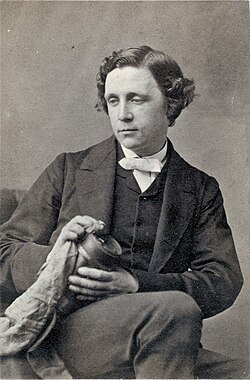
Carroll is the only author for whom, as far as I know and can find, I have read every published work. Carroll’s version of whimsical, magical realism captivates me and to some degree explains why I love the work of the modern authors Haruki Murakami (old favorite) and Gabriel Garcia Marquez (recent favorite). Another thing I love about Carroll’s work is the illustrations, not only Sir John Tenniel’s famous illustrations in the Alice books, also Henry Holiday’s inspired illustrations in The Hunting of the Snark, Arthur B. Frost’s depictions in in A Tangled Tale, and Harry Furniss’ illustrations in the Sylvie and Bruno books. In each case, the wonderful illustrations add a lot to the story. I’d love to see that type of artist illustrate Sir Terry Pratchett’s books. If you haven’t checked out Carroll since you were a kid, try the Hunting of the Snark for a bit of silliness in eight Fits.
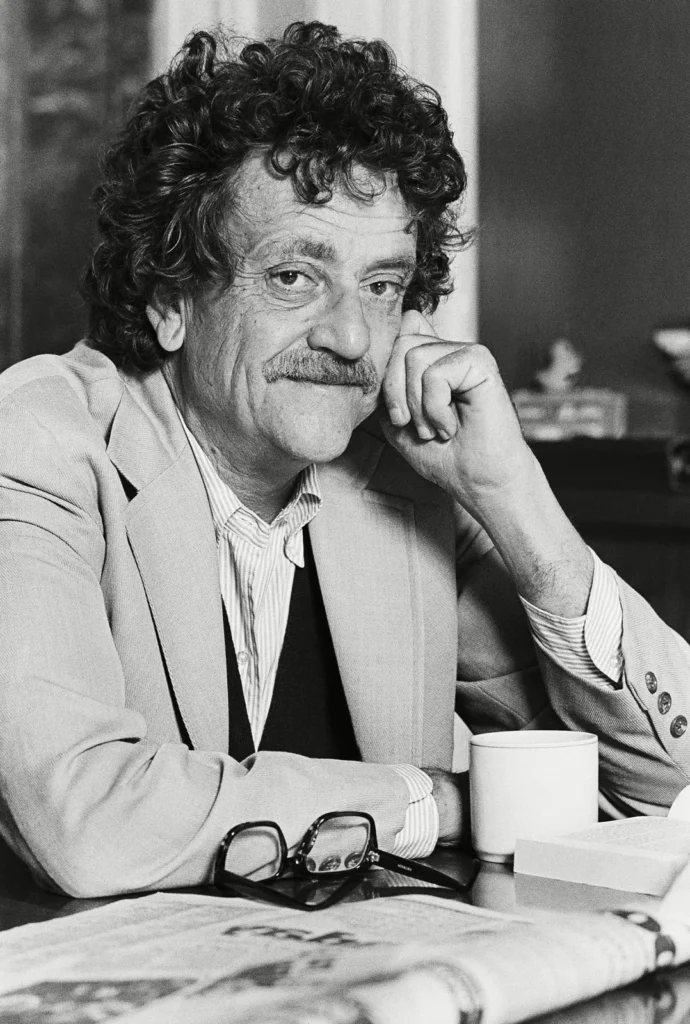
I loved the way Vonnegut explored his experiences in Dresden as a P.O.W., his insights into human behavior, and the overwhelming humanity of his characters. I picked up Cat’s Cradle again and suddenly, I got it. I then ate up Vonnegut’s other earlier works, which to this day are still my favorites, among them: Mother Night, Breakfast of Champions, God Bless You Mr. Rosewater, Welcome to the Monkey House, and the brilliant book of essays and observations, Wampeters, Foma, and Granfalloons. Humanity times a zillion. If you’re new to Vonnegut, I suspect Slaughterhouse Five or maybe God Bless You, Mr. Rosewater would be a good place to start.
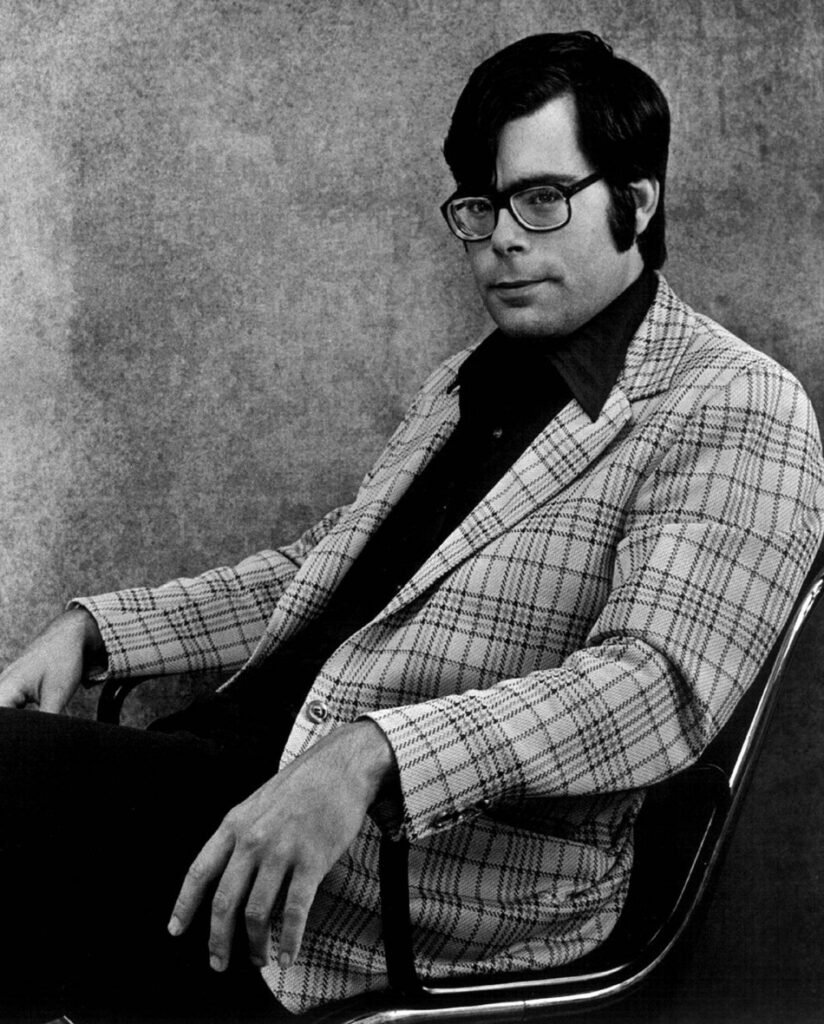
The first King book I read was The Stand, soon enough after it came out that it was only available in hardback. That book wowed young writer me. I saw how King did spent time letting us get to know his characters and captivating us with their somehow fascinating everyday activities as they crawled across the country coalescing into two camps, good and evil. It was a tour de force of characterization unlike any I had ever read, and even now, that’s still true, I haven’t read anything like it. King is a master at creating characters and exposing them to you, so you get to know and feel them in all their glory and in all their gory.
The Stand is still my favorite King fiction book. Other favorites include The Dead Zone, Different Seasons, Night Shift, Skeleton Crew, Salem’s Lot, and The Shining. For non–fiction, King’s On Writing is one of the few books about how to write that’s well worth reading and that might actually help you.
The Stand is still my favorite King fiction book. Other favorites include The Dead Zone, Different Seasons, Night Shift, Skeleton Crew, Salem’s Lot, and The Shining. For non–fiction, King’s On Writing is one of the few books about how to write that’s well worth reading and that might actually help you.

Deliberately anachronistic humor pops up all over the place, from characters like Cohen the Barbarian (I imagine Michael Palin playing him in the movie version in my mind) to Shakespeare analogs and much more. Pratchett’s humor, innovative and playful, keeps you grinning and even chuckling out loud throughout every book. His world builds over each book courtesy of a legion of memorable, unique recurring characters. Many characters appear in multiple books; a lead character in one book could be a minor character in another. And yet, you don’t have to read the books in order. It doesn’t hurt to do so, but it doesn’t hurt not to do so, with the exception of the first two books (the second book continues the first book’s story). Read any Pratchett book and you’ll be hooked too.
I love the way Murakami blends the mundane, ordinary world and its mundane, ordinary experiences with the surreal, with magic lurking just under the edges of the rug of reality that covers an unknown universe beneath. He integrates the magical with the mundane in such a natural way that you don’t question it when you read, even if you’ve just gone from the character preparing and eating an ordinary meal to having a conversation with an impish apparition. I’ve read 18 of Murakami’s books, 19 if you count the early short novels Wind/Pinball as two books, although in the edition I have, they’re both in one book. Pinball, as is noted multiple times in the story, is not about pinball. But it is. But it isn’t. I think I like that story better than Murakami does. If you’ve never read Murakami, I recommend starting with Kafka on the Shore, as I did.
(That’s OK. When I loan a book, I don’t always expect to get it back. I loan it because I believe the person to whom I’m loaning it will like it and get something out of it, and that’s enough for me. If I love the book and want to share it, losing it until I buy it again is a small price to pay.). I love the way Murakami blends the mundane, ordinary world and its mundane, ordinary experiences with the surreal, with magic lurking just under the edges of the rug of reality that covers an unknown universe beneath. He integrates the magical with the mundane in such a natural way that you don’t question it when you read, even if you’ve just gone from the character preparing and eating an ordinary meal to having a conversation with an impish apparition. I’ve read 18 of Murakami’s books, 19 if you count the early short novels Wind/Pinball as two books, although in the edition I have, they’re both in one book. Pinball, as is noted multiple times in the story, is not about pinball. But it is. But it isn’t. I think I like that story better than Murakami does. If you’ve never read Murakami, I recommend starting with Kafka on the Shore, as I did.

Stories to entertain, mystify,
and provoke the imagination
Stories to entertain, mystify, and provoke the imagination
info@sleitnerbooks.com
+62 832-6200-86263
Designed by : Thrill Edge Technologies
Copyright © 2025. All rights reserved